



Difference Between Steel Beams, Angles and Channels | Uses and How to Choose the Right Section
Steel beams, angles, and channels are among the most widely used commercial steel sections in construction, structural steelwork, industrial projects, and metal fabrication.
Each steel section has a different shape, structural performance, and application. Understanding these differences helps contractors, engineers, fabricators, and project owners select the right steel section for their projects.
What Are Steel Beams?
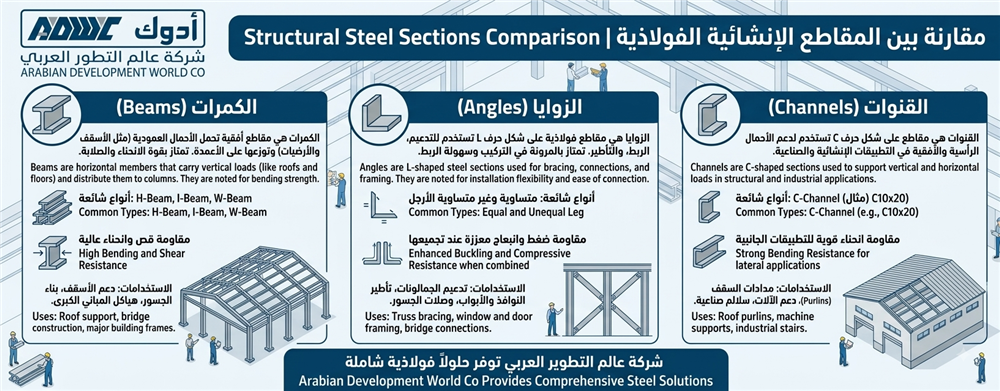
Steel beams are structural steel sections primarily used to support and transfer loads. Common beam profiles include I-sections and H-sections.
Their structural design provides good resistance to bending and allows them to carry significant loads when properly designed and installed.
Common Applications of Steel Beams
Structural steel buildings.
Warehouses and factories.
Bridges and industrial structures.
Steel columns and supports.
Roof structures.
Heavy-duty structural applications.
Industrial construction projects.
The load-bearing capacity of a steel beam depends on its profile, dimensions, thickness, steel grade, span, loading conditions, and structural design.
What Are Steel Angles?
Steel angles are metal sections with an L-shaped profile. They are widely used in structural steelwork, reinforcement, metal fabrication, and industrial applications.
Steel angles are available in various sizes and thicknesses and can be used individually or combined with other steel sections.
Common Applications of Steel Angles
Steel structures.
Structural reinforcement.
Metal frames and supports.
Steel bases and brackets.
Doors and windows.
Welding and fabrication.
Structural connections.
Industrial applications.
One of the main advantages of steel angles is their versatility and ease of cutting, welding, and fabrication.
What Are Steel Channels?
Steel channels, also known as Channel Sections, are steel sections with a profile similar to the letter U or C.
They are widely used in structural supports, frames, industrial structures, equipment bases, and metal fabrication.
Steel channels are available in different sizes and thicknesses and should be selected according to the project's requirements and engineering design.
Common Applications of Steel Channels
Structural steelwork.
Supports and bases.
Industrial structures.
Metal frames and chassis.
Equipment and machine structures.
Reinforcement.
Construction and fabrication projects.
Difference Between Steel Beams, Angles and Channels
| Steel Section | Profile | Common Applications | Main Advantage |
|---|---|---|---|
| Steel Beam | I or H | Structures and heavy loads | High load-bearing capability |
| Steel Angle | L | Reinforcement and fabrication | Easy to cut and weld |
| Steel Channel | U or C | Supports, frames and structures | Versatile applications |
How to Choose the Right Steel Section
Selecting the correct steel section depends on several important factors.
1. Project Type
Determine whether the section will be used for a building, warehouse, factory, steel frame, support, base, or another application.
2. Loads
The expected loads should be evaluated before selecting the steel section. This is particularly important for load-bearing structural applications.
3. Dimensions and Thickness
Steel sections are available in different sizes and thicknesses. The appropriate dimensions should be selected according to the project's technical requirements.
4. Connection Method
Consider how the steel section will be installed or connected, whether through welding, bolts, or other structural connections.
5. Technical Specifications
The selected steel should meet the applicable technical specifications and standards required for the project.
6. Engineering Design
For structural load-bearing applications, the appropriate steel section should be determined through engineering calculations and structural design by a qualified engineer.
Which Is Better: Steel Beams, Angles, or Channels?
There is no single steel section that is best for every application.
Steel beams are commonly used for structural elements requiring high load-bearing capacity.
Steel angles are widely used for reinforcement, brackets, supports, connections, and metal fabrication.
Steel channels are versatile sections commonly used in frames, supports, structures, and industrial applications.
Therefore, the best steel section is the one that matches the project's design, loads, dimensions, and intended application.
Buying Steel Beams, Angles and Channels in Riyadh
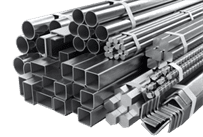
If you are looking for commercial steel in Riyadh, Arab Development World Company provides various steel sections for construction, industrial, and fabrication projects, including steel beams, angles, channels, pipes, and steel plates.
Before purchasing, it is recommended to determine the required dimensions, quantities, specifications, and project requirements to ensure the correct product is selected and material waste is minimized.
Conclusion
Steel beams, angles, and channels differ in their profiles, applications, and structural performance.
Steel beams are commonly used for structural elements requiring high load-bearing capacity, while steel angles are widely used for reinforcement and fabrication. Steel channels are suitable for supports, frames, and various industrial structures.
Selecting the correct steel section can improve project efficiency, reduce material waste, and help control costs. For structural applications, the final selection should be based on engineering design, technical specifications, and appropriate structural calculations.
.png)
- السجل التجاري : 1010298801
- الرقم الضريبي : 300438467100003