



Types of Steel Beams and Their Uses
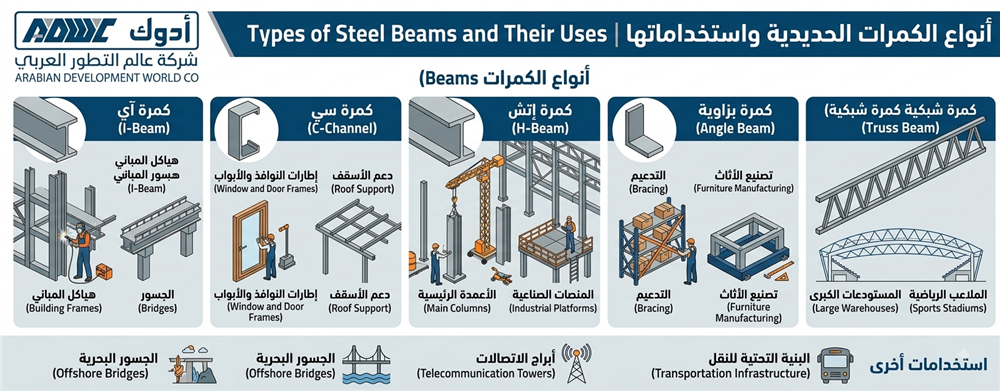
Types of Steel Beams and Their Uses
Introduction
Steel beams are among the most important structural components used in construction and steel structures. They are designed to carry loads and transfer them to columns and foundations. Steel beams come in different shapes, sizes, thicknesses, and load capacities, making the selection of the appropriate beam essential for the strength and stability of a structure.
1. H-Beams
H-Beams have a wide cross-section that resembles the letter H. They are designed to provide high load-bearing capacity and good structural stability.
Common uses include:
- Steel building structures.
- Warehouses and factories.
- Bridges and industrial structures.
- Main beams and columns.
- Heavy-duty construction projects.
2. I-Beams
I-Beams have a cross-section similar to the letter I. Their shape provides efficient resistance to bending, making them widely used in structural construction.
Common uses include:
- Steel buildings and structures.
- Roof structures.
- Bridges.
- Industrial platforms.
- General construction applications.
3. U-Beams / Steel Channels
U-Beams, commonly known as Steel Channels, have a U-shaped cross-section and are widely used in construction and metal fabrication.
Common uses include:
- Steel structures.
- Door and frame manufacturing.
- Metal supports.
- Equipment bases.
- Industrial and workshop applications.
4. Box Beams
Box Beams have a closed cross-section, providing good stiffness and resistance to twisting and torsional forces.
Common uses include:
- Heavy steel structures.
- Bridges.
- Industrial facilities.
- Structures exposed to loads from multiple directions.
- Projects requiring high torsional resistance.
How to Choose the Right Steel Beam
Selecting the appropriate steel beam depends on several factors, including:
- The type and magnitude of loads.
- The span between supports.
- The type of construction project.
- The beam's connection and support conditions.
- Engineering design requirements.
- Applicable project standards and specifications.
The beam size and type should always be determined according to approved structural drawings and engineering calculations. The correct selection depends not only on the beam's shape but also on the expected loads, structural conditions, and design requirements.
Conclusion
Steel beams are available in various shapes, sizes, and load capacities, with each type designed for specific applications. Choosing the appropriate beam is essential for achieving safe, strong, and efficient steel structures.
If you are looking for steel beams and building materials in Riyadh, Arab Development World Company provides a range of commercial steel products and building materials to meet the requirements of contractors and construction projects.
.png)
- السجل التجاري : 1010298801
- الرقم الضريبي : 300438467100003